Wildfire Hardening Becomes Critical for Hotel Insurance
Physical mitigation and defensible space now dictate insurability as carriers price wildfire risk directly at the asset level.
The short answer
Surging property coverage costs and asset-level underwriting are forcing hotel owners to prioritize wildfire hardening and Zone 0 defensible space. A 21-day wildfire shutdown can wipe out up to 20 percent of a hotel's annual EBITDA.
The short version
- IBHS research indicates that fuel on more than 25 percent of the ground within 5 feet of a structure raises damage likelihood near 90 percent.
- CBRE data shows resort property insurance costs averaged $2,464 per room in 2022 compared to $528 for limited-service properties.
- STR recorded occupancy surges to 83 percent across surviving Glendale, Burbank, and Pasadena hotels during the 2025 Los Angeles fires.
Wildfire hardening determines whether a hotel remains insurable, financeable, and open for business during regional fire emergencies [1]. Insurance carriers now underwrite individual properties based on envelope assemblies and defensible space [1]. Physical hardening protects cash flow, as a three-week forced shutdown absorbs roughly 15 to 20 percent of an average property's annual EBITDA [1].
Why does wildfire hardening directly dictate hotel insurability?
Wildfire hardening dictates insurance access because underwriting has shifted from broad zip codes directly to asset-level structural assessments [1]. As CBRE's Trends in the Hotel Industry survey showed, hotel insurance premiums remain roughly double 2019 levels following consecutive years of double-digit rate hikes [1]. Resorts face the heaviest burden, averaging $2,464 per available room in 2022 compared to $528 per room for limited-service assets [1].
Carriers now inspect whether an owner maintains defensible perimeters and ignition-resistant building envelopes [1]. While physical mitigation earns modest direct premium discounts, its primary return is preserving coverage [1]. Uninsurable properties cannot secure debt financing [1]. With industry performance running flat occupancy and EBITDA up just 0.3 percent, three weeks without revenue while fixed costs run uninterrupted drains 15 to 20 percent of a normal year's EBITDA, threatening single-asset solvency [1].
How do wildfires shut down undamaged hotel properties?
A hotel does not require direct flame contact to face a catastrophic operational shutdown [1]. Smoke infiltration through air handlers, regional utility power cutoffs during red-flag weather, civil authority evacuations, water pressure drops, and blocked access roads can fully halt operations [1]. During these shutdowns, debt service, property taxes, insurance premiums, and brand licensing fees continue without pause [1].
Standard insurance policies offer limited relief during non-flame closures [1]. Lodging Magazine reported that business interruption coverage standardly enforces a 48- to 72-hour waiting period [1]. Civil authority coverage limits payouts to two to four weeks, while smoke contamination absent physical structural destruction rarely triggers indemnity [1]. Consequently, the financial liability of extended wildfire closures falls squarely on the property owner [1].
What physical building features reduce structural wildfire losses?
Integrated building assemblies significantly outperform isolated upgrades during fire events [1]. The Insurance Institute for Business & Home Safety (IBHS) evaluated over 250 properties across the Eaton and Palisades burn scars in Southern California [1]. Properties combining a Class A roof, noncombustible exterior cladding, dual-pane window glazing, and enclosed eaves avoided destruction 54 percent of the time [1]. Structures containing only one of those four components escaped damage in only 36 percent of incidents [1].
| Assembly / Exposure Factor | Observed Structural Impact | Source / Entity |
|---|---|---|
| Fuel covering >25% of ground within 5 feet (Zone 0) | Damage or destruction likelihood near 90% | IBHS Post-Fire Assessment [1] |
| Class A roof, cladding, dual-pane glass, enclosed eaves | 54% avoided damage rate | IBHS Post-Fire Assessment [1] |
| Single hardened envelope feature only | 36% avoided damage rate | IBHS Post-Fire Assessment [1] |
| Building-to-building separation of 8 to 14 feet | Full conflagration between structures | IBHS Post-Fire Assessment [1] |
| Building-to-building separation of 30 to 70 feet | Scattered ignitions only | IBHS Post-Fire Assessment [1] |
| Enhanced assembly construction cost premium | ~3% addition to affected components | IBHS / Headwaters Economics [1] |
| Resort insurance premium per available room (2022) | $2,464 per room | CBRE Trends Survey [1] |
| Limited-service insurance premium per room (2022) | $528 per room | CBRE Trends Survey [1] |
Data from IBHS and Headwaters Economics shows that incorporating this enhanced standard adds approximately 3 percent to affected component costs [1]. Commercial properties can execute envelope modernizations during scheduled roof replacements or brand-mandated property improvement plans [1].
Why is Zone 0 landscaping the most urgent operational fix?
Zone 0 landscaping yields the highest loss reduction per dollar spent across any asset [1]. IBHS findings revealed that when combustible material—such as bark mulch, dead brush, or stacked pool furniture—covered more than 25 percent of the ground within 5 feet of an exterior wall, structural loss or severe damage approached 90 percent [1]. Clearing this perimeter requires minimal labor and can be executed over a single operational weekend [1].
Regulatory frameworks are making this baseline mandatory [1]. California approved statewide Zone 0 mandates in August covering commercial real estate, which will phase in over a three- to five-year implementation window [1]. Replacing organic mulch with gravel, stone, and architectural desert landscaping prevents exterior ignitions while matching premium aesthetic standards [1].
How do guest room PTAC units present unique fire hazards?
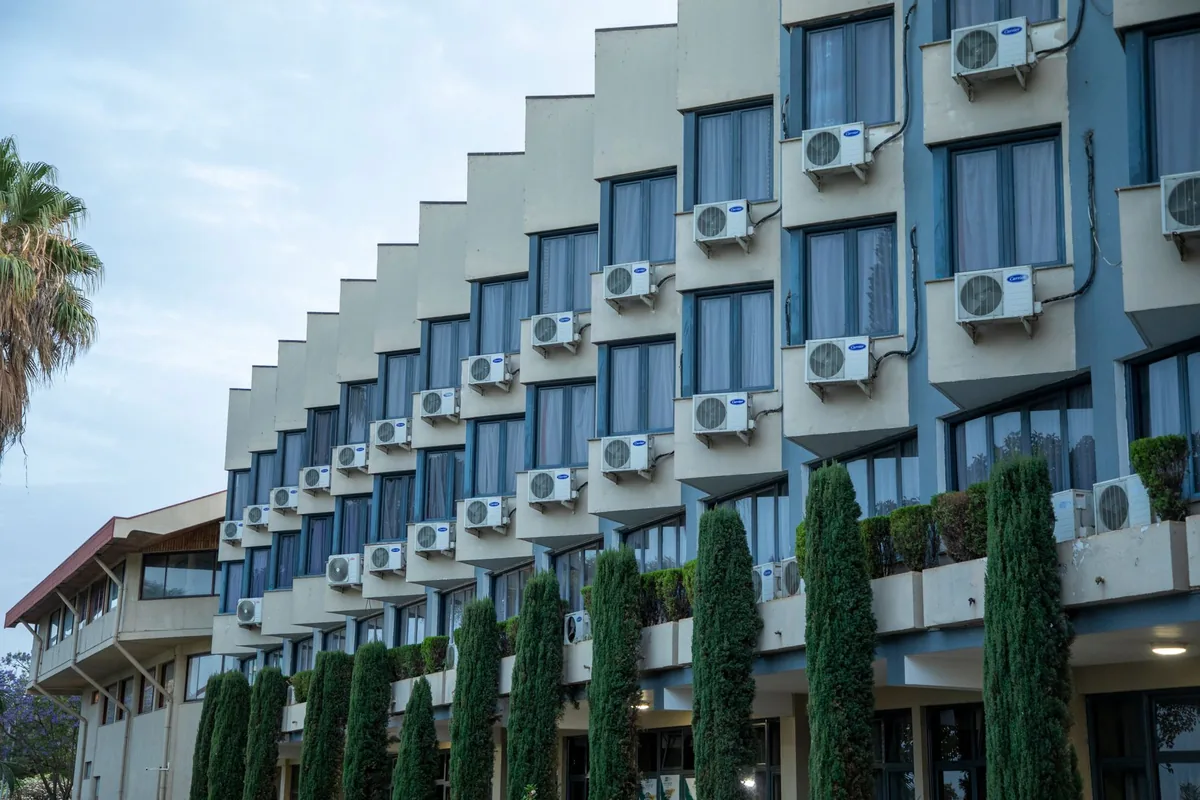
Packaged Terminal Air Conditioner (PTAC) units create an envelope opening that traditional municipal fire codes overlook [1]. Standard hotel fire barriers are engineered to contain blazes starting inside the interior footprint, regulating corridor assemblies and door closures [1]. Conversely, wildfire exposure strikes inward through exterior walls [1].
A typical 140-key select-service hotel maintains 140 through-wall penetrations under guest windows [1]. PTAC louvers pull exterior ambient air directly into guest rooms without meeting specialized vent protection criteria [1]. Operators must inspect mechanical dampers, upgrade intake filtration, and establish explicit engineering protocols to seal these openings before smoke or embers penetrate the room inventory [1].
What design choices determine business capture after a wildfire?
Hardened infrastructure enables surviving properties to capture immediate surge demand generated by displaced residents and recovery personnel [1]. During the January 2025 Eaton and Palisades blazes in Los Angeles County, hotels in Pasadena, Glendale, and Burbank posted 83 percent occupancy, jumping from 63.7 percent during the comparable period a year earlier, according to STR data [1]. Conversely, after the 2017 Tubbs Fire consumed the Hilton Sonoma Wine Country, that site sat predominantly vacant for six years [1].
Reopening velocity depends heavily on physical planning decisions made years earlier [1]. Equipping buildings with full-capacity secondary generators provides uninterrupted power, Wi-Fi, and kitchen services when public utilities initiate safety cutoffs [1]. Furthermore, installing on-site dedicated water storage and standard, locally sourced building materials prevents protracted shutdowns [1]. Specifying custom imported architectural products with 20-week lead times guarantees prolonged closures when area trades face severe post-disaster backlogs [1].
Reported by
This article was written from the following reporting. Follow the links for the original coverage.
- [1]Wildfire Hardening Becomes Critical for Hotel Insurance— Lodging Magazine
Frequently asked
+Why is hotel wildfire hardening suddenly mandatory for insurance?
Insurers now underwrite risks at the individual asset level rather than by zip code. With average resort insurance premiums reaching $2,464 per room according to CBRE, documented ignition-resistant construction and defensible space are necessary to secure underwriting and loan financing [[1]].
+What is the Zone 0 requirement for commercial properties?
Zone 0 mandates a noncombustible buffer within 5 feet of a structure. Research shows that having combustible material across more than 25 percent of this perimeter elevates the rate of building destruction to nearly 90 percent during a wildfire [[1]].
+Does business interruption insurance cover all wildfire shutdowns?
No. Business interruption policies routinely impose a 48- to 72-hour waiting period, civil authority coverage generally caps out at two to four weeks, and smoke odor without verified structural damage rarely triggers claim settlements [[1]].
+How vulnerable are guest room PTAC units during wildfires?
A 140-room hotel contains 140 exterior wall penetrations through PTAC louvers. These intake systems bypass traditional interior fire barriers, allowing smoke and airborne embers to enter guest rooms unless manual or automatic dampening protocols are established [[1]].
+How much does structural wildfire hardening add to construction budgets?
Integrating a Class A roof, noncombustible cladding, dual-pane glass, and enclosed eaves adds approximately 3 percent to the cost of affected building elements, while improving structural survival rates from 36 percent up to 54 percent [[1]].
+How does operational readiness affect post-disaster hotel performance?
Hotels that remain operable capture severe market displacement demand. During the January 2025 Los Angeles County wildfires, surviving hotels in Burbank, Pasadena, and Glendale achieved 83 percent occupancy compared to 63.7 percent the previous year, according to STR [[1]].
Keep reading
Our reporting


More in operations